Hi everyone!
For my presentation, I'd like us to talk about the Gregg article, "The Normalisation of Flexible Female Labour in the Information Economy." The article discusses the concept of flexible labour, the assumptions behind this practice and the effect that it has on women in particular. Gregg suggests that while women are now given more choices and opportunities to travel or work from home, it would be wrong to conclude that flexible labour has only brought benefits and that it has been so for all women.
I will focus on two of Gregg's most significant points. The first is that women are geared towards flexible labour because of traditional (and restricted) understandings of gender. The second is that the representation of flexible labour in the media is inaccurate.
To get your views on the points that Gregg raises, I have prepared the following questions:
1. Has the emergence of flexible labour put more pressure on women by expecting them to be BOTH successful workers and homemakers? Do you think childrearing should be treated as a matter external to the economy?
2. What is your view on how flexible labour has been presented? Is flexible labour the IDEAL working arrangement?
Lastly, In my analysis of flexible labour, I also found that it recalls a number of binary oppositions such as masculine/feminine, work/leisure, etc. I'd like to know if you think flexible labour changes our perceptions of any of these dualisms.
Thank you and see you on Wednesday! :)
Monday, October 11, 2010

Tutorial Presentation Week 11 – Work and Play
This week I will look at the forward by Henry Jenkins and Justine Cassell, written for Beyond Barbie and Mortal Kombat: new perspectives on gender and gaming edited by Yasmin B. Kafai.
From Quake Grrls to Desperate Housewives: A Decade of Gender and Computer Games looks at the development of the computer game scene since the 1997 conference Jenkins and Cassell held which focused on the girl game movement and what it would take to expand the female market of games.
This forward covers the ideas of: Can, do and should girls play computer games.
Why women are still under-represented in the design and digital technology fields.
The girls game movement of the mid 90's and it's conflicting aims. Which include the economic drive for marketing towards females, the political aspect attempting to shrink the gap between the genders by getting girls interesting in computer, the technological introduction of the CD-ROM and it's ramifications, the entrepreneurial aspect for women starting up new businesses focusing on girls games and the aesthetics developed for girls games upping the ante on visual and audio game experiences.
Attitudes towards women and the reasons discussed as to why they don't design/play computer games. Stereotypes and 'pink box' thinking.
What girls want to play and how to get them to play.
It appears that these days the only time games are marketed towards women are when the game companies want to try and expand their market and earn more profits. Not for the sake of making games for women who would enjoy the experience, and thus want to be a regular gamer. The 90's girl game movement saw many startup companies focusing on girls games, they had a smaller marketing base in comparison to Sony and Nintendo for example, so didn't have the capability to expand very far. I've linked a talk given by Brenda Laurel in 1998 where she explains about the software company she started up which was designed to make games for girls and the approaches she took to ensure that the games would be what girls wanted to play. Her approach, to me at least, seems to make more sense then trying to market a 'boys game' for girls.
Some questions I would like to look at are: The number of female gamers has increased but not the number of designers. How many other fields are there where there are plenty of participating women but not nearly as many 'movers and shakers' of the field? Why is that? Is there any truth to the idea that there are some things that men do and some things that women do better, and that's where this divide occurs?
Do you think the computing industry is actively trying to get more women to play their games/ become software designers? What approaches do they/could they take? Is it in their interest to try and attract more women?
Has there been an increase in the number of 'games for girls' or is it just clever marketing to get girls into boys games?
Do you play computer games? Would you consider them male or female games? Or are the terms butch and femme more appropriate?
Has there been much development in games since the 90's in making them more accessible to everyone?
Reflection: Gaga for Gaga
Published in The Weekend Australian magazine of September 25-26, was a very interesting and relevant article written by feminist critic, Camille Paglia. In “The World’s Gone Gaga”, Paglia undertakes a critical, if not, scathing analysis of the pop icon, Lady Gaga. (A subject of discussion for all of you at some point, I am sure). Paglia claims that Lady Gaga is “the first megastar of the digital age” and that “her success only shows how culturally impoverished we have become … living in an era of miniaturisation, image saturation and manipulation … and in a disconnection from nature”. While there is no questioning Paglia’s observation that we are in fact living within a digital age, does she gone too far to claim Gaga as a highly superficial, “manufactured personality” and as a “plasticised android”?
Paglia claims that Gaga is a mere replica: whose persona is founded on the copying, duplicating and apparent blatant forgery of past pop identities such as David Bowie, Madonna, Cher, Isabella Blow, Marlene Dietrich, Andy Warhol, Theda Baras, Clara Bow, Marylin Monroe, Jane Fonda, Gwen Stefani, Jane Russell … the list goes on. Paglia states that Gaga, through imitating such personalities (all of whom are understood by Paglia to be ‘authentic’), is essentially a living cliché. An agglomerative pastiche of artificial personas and superficial characters, who lack depth, originality and substance.
However what marks Gaga differently to her predecessors, and valorises her concept to a certain extent, is her usage of the internet (the very environment from which Gaga has manifested). However Paglia goes deeper then this to argue Gaga’s popularity and success through the consequences, effects and bi-products of the internet and the digital age. Paglia identifies the blurring borderlines that the internet has created between the real and the fake; the true and the false; the primary from the secondary; the virtual from the real; the public and the private, claiming “… in the sprawling anarchy of the web, the boarderline between fact and fiction melt away” Furthermore, Gagas fans, aged predominantly in their teens to tweens are “marooned in a global technocracy of fancy gadgets but emotional poverty. Everything is refracted for them through the media … processing reality as cluttered, de-centred environment of floating bits”. It seems that Paglia has adopted a very post-modern critique of Lady Gaga and the internet generation. However is Paglia correct in making such assumptions?
The lack of engagement with the real world by the Gaga generation has been the responsibility, or at least aided by their current obsession with the digital age, whose iPods, mobile phones and keyboards have become “sticky extensions of their bodies”, who “have abandoned body language in daily interactions … are not attuned to facial expressions and communicate mutely via a constant stream of atomised, telegraphic text messages…” This observation by Paglia, is an apt one. The current generational obsession with technology, gadgets and mew media is limiting people’s capacities to engage within the real world. It seems to me that in a world in which people are constantly surrounded by noise, gizmos and gadgets (I am not talking here of street or the sound of people socialising in a bar or a café, but rather the noise of glitching mobile phones, the clicking of iPod wheels, the beeping of pagers, the constant drumming of music, advertising and television) are infact becoming increasingly uncomfortable within the real or natural world and their capabilities to interact with it, is diminishing. Perhaps the current obsession with Lady Gaga, who seems to be a highly constructed, refracted and digitalised character, devoid of humanistic qualities or artistic talent, is an apt reflection of a media-obsessed generation whose diminishing social capabilities and lack of real world engagement is a direct result of a life lived on the net.
Cheers,
Blake Chitty.
Paglia claims that Gaga is a mere replica: whose persona is founded on the copying, duplicating and apparent blatant forgery of past pop identities such as David Bowie, Madonna, Cher, Isabella Blow, Marlene Dietrich, Andy Warhol, Theda Baras, Clara Bow, Marylin Monroe, Jane Fonda, Gwen Stefani, Jane Russell … the list goes on. Paglia states that Gaga, through imitating such personalities (all of whom are understood by Paglia to be ‘authentic’), is essentially a living cliché. An agglomerative pastiche of artificial personas and superficial characters, who lack depth, originality and substance.
However what marks Gaga differently to her predecessors, and valorises her concept to a certain extent, is her usage of the internet (the very environment from which Gaga has manifested). However Paglia goes deeper then this to argue Gaga’s popularity and success through the consequences, effects and bi-products of the internet and the digital age. Paglia identifies the blurring borderlines that the internet has created between the real and the fake; the true and the false; the primary from the secondary; the virtual from the real; the public and the private, claiming “… in the sprawling anarchy of the web, the boarderline between fact and fiction melt away” Furthermore, Gagas fans, aged predominantly in their teens to tweens are “marooned in a global technocracy of fancy gadgets but emotional poverty. Everything is refracted for them through the media … processing reality as cluttered, de-centred environment of floating bits”. It seems that Paglia has adopted a very post-modern critique of Lady Gaga and the internet generation. However is Paglia correct in making such assumptions?
The lack of engagement with the real world by the Gaga generation has been the responsibility, or at least aided by their current obsession with the digital age, whose iPods, mobile phones and keyboards have become “sticky extensions of their bodies”, who “have abandoned body language in daily interactions … are not attuned to facial expressions and communicate mutely via a constant stream of atomised, telegraphic text messages…” This observation by Paglia, is an apt one. The current generational obsession with technology, gadgets and mew media is limiting people’s capacities to engage within the real world. It seems to me that in a world in which people are constantly surrounded by noise, gizmos and gadgets (I am not talking here of street or the sound of people socialising in a bar or a café, but rather the noise of glitching mobile phones, the clicking of iPod wheels, the beeping of pagers, the constant drumming of music, advertising and television) are infact becoming increasingly uncomfortable within the real or natural world and their capabilities to interact with it, is diminishing. Perhaps the current obsession with Lady Gaga, who seems to be a highly constructed, refracted and digitalised character, devoid of humanistic qualities or artistic talent, is an apt reflection of a media-obsessed generation whose diminishing social capabilities and lack of real world engagement is a direct result of a life lived on the net.
Cheers,
Blake Chitty.
The Simpsons - Banksy Style
Hey Guys
I came across this video today which I thought was an interesting take on the whole issue of sweatshops. Remember that the Simpsons franchise is owned by Fox, part of the News Ltd group of companies. It is an interesting take on hacktivism and the ideas that we covered surrounding that topic but also the topics we looked at in todays workshop.
This title sequence was actually designed by British Graffiti artist Banksy.
Cheers,
Luke
I came across this video today which I thought was an interesting take on the whole issue of sweatshops. Remember that the Simpsons franchise is owned by Fox, part of the News Ltd group of companies. It is an interesting take on hacktivism and the ideas that we covered surrounding that topic but also the topics we looked at in todays workshop.
This title sequence was actually designed by British Graffiti artist Banksy.
Cheers,
Luke
Week 10 Reflection: Alter Ego
This is a blog post posted by Mark Jones discussing Alter Ego, a documentary profiling members of the online gaming community of Second Life. I have found that Second Life has popped up in a number of our discussions of virtual communities, the ways in which these communities can be a reflection of the 'real-world' and the potential for avatars to become an extension of the individual self. Unfortunately the documentary has been removed from the sbs website but I managed to find a short clip from the documentary detailing a couple who live out their dream lives on Second Life.
It is interesting to see the way in which Blair and Alegria view Second Life as an opportunity to live their "real life dreams", dreams that they view as difficult to attain in their offline lives. Blair and Alegria's avatars as not only an extension of themselves but an improved version of their offline identities and bodies. Alegria reveals that in Second Life she is able to have larger breasts without having surgery and blond hair without using peroxide. It is interesting to see how the short clip juxtaposes their offline lives with their Second Life virtual realities. In Second Life Blair is a DJ with an potential worldwide audience of half a million people and Alegria is a successful fashion designer. In their offline lives they clean cars for a living and live in a modest home. The offline activities they undertake are constructed as mundane in comparison to the fantasy lives they live in Second Life.
I think this clip demonstrates the ways in which virtual realities have the potential to intertwine with 'real life'. Alegria is able to make 'real world' money with her online creations and Blair has paid hundreds of dollars to attain his sought after looks in Second Life. They are both able to live in an environment where they have greater control over their looks, the activities they undertake and the sucess they experience in life. They are able to achieve greater validation and pleasure from the lives they live on Second Life as opposed to their 'real lives' and it is because of this that Alegria and Blair choose to spend more time living life "in there". On that note here is another short documentary on a member of the Second Life virtual community. I think this further demonstrates the way we can construct and have control over our online identity and the way we choose to present ourselves to others within a controlled environment.
It is interesting to see the way in which Blair and Alegria view Second Life as an opportunity to live their "real life dreams", dreams that they view as difficult to attain in their offline lives. Blair and Alegria's avatars as not only an extension of themselves but an improved version of their offline identities and bodies. Alegria reveals that in Second Life she is able to have larger breasts without having surgery and blond hair without using peroxide. It is interesting to see how the short clip juxtaposes their offline lives with their Second Life virtual realities. In Second Life Blair is a DJ with an potential worldwide audience of half a million people and Alegria is a successful fashion designer. In their offline lives they clean cars for a living and live in a modest home. The offline activities they undertake are constructed as mundane in comparison to the fantasy lives they live in Second Life.
I think this clip demonstrates the ways in which virtual realities have the potential to intertwine with 'real life'. Alegria is able to make 'real world' money with her online creations and Blair has paid hundreds of dollars to attain his sought after looks in Second Life. They are both able to live in an environment where they have greater control over their looks, the activities they undertake and the sucess they experience in life. They are able to achieve greater validation and pleasure from the lives they live on Second Life as opposed to their 'real lives' and it is because of this that Alegria and Blair choose to spend more time living life "in there". On that note here is another short documentary on a member of the Second Life virtual community. I think this further demonstrates the way we can construct and have control over our online identity and the way we choose to present ourselves to others within a controlled environment.
Sunday, October 10, 2010
Week 10 Reflection
Enhanced Reality
It's becoming incredibly close. In fact many iPhone and smart phone applications can be defined as 'enhanced reality'. Applications like Google maps and Streetview already bridge the distance between the digital world and the physical world in everyday navigation. New technologies are being developed now that will integrate those types of applications with our vision. In 5 to 10 years, as this SBS news article puts it, "our eyes alight for the first time on a skyscraper in a foreign cityscape, a disembodied voice whispers in your ear the phone number of a posh bar on the top floor."
Things will certainly be interesting when you can instantly see someone's Facebook profile just from looking at them at on the bus.
It's becoming incredibly close. In fact many iPhone and smart phone applications can be defined as 'enhanced reality'. Applications like Google maps and Streetview already bridge the distance between the digital world and the physical world in everyday navigation. New technologies are being developed now that will integrate those types of applications with our vision. In 5 to 10 years, as this SBS news article puts it, "our eyes alight for the first time on a skyscraper in a foreign cityscape, a disembodied voice whispers in your ear the phone number of a posh bar on the top floor."
Things will certainly be interesting when you can instantly see someone's Facebook profile just from looking at them at on the bus.
Online Communities as Countries
Hey Guys
This picture looks at the idea of online communities as simply being another form of country. It is an interesting thing to consider when the membership of Facebook is larger than some "real life" countries.
Just something to think about,
Luke
This picture looks at the idea of online communities as simply being another form of country. It is an interesting thing to consider when the membership of Facebook is larger than some "real life" countries.
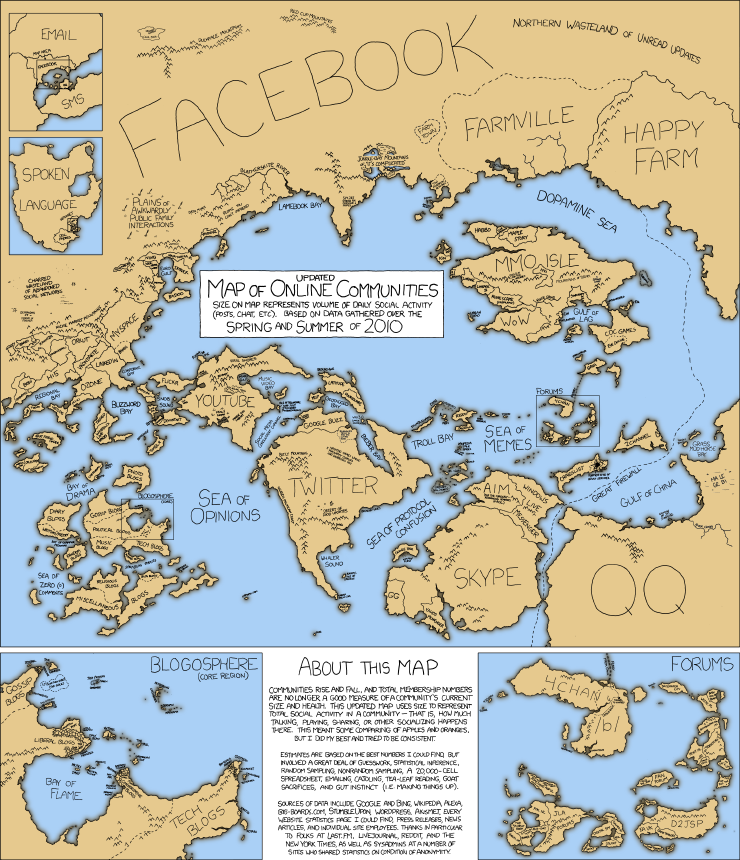
Just something to think about,
Luke
Week 10 Reflection: "Eyeborg"
This blog follows Rob Spence, a Canadian filmmaker, was the victim of an accident in his childhood that damaged his right eye, and he was later given a prosthetic replacement. While for a long time he was content with the replacement, he recently decided to fit a camera inside the empty cavity, turning himself into a self-proclaimed “Eyeborg.”
Now, while he is currently working towards the goal of putting a camera in the socket, he has decided to divert for the time being and outfit himself with the stylish red LED - this is the first time he’s been able to fit an electronic device and a power source inside.
Reportedly, the camera will record anything that enters his field of vision, and will relay that image back to a computer, providing a very unique perspective (as far as video surveillance is concerned).
This reminds me of the JenniCam that we discussed earlier in the semester, and puts a new spin on a 'documentary' being from that persons perspective - considering we will literally see through his eye(s).
Whether or not we will see anything but the ordinary life of one of our fellow human beings is another question - but the idea of seeing from someone else's perspective seems somewhat cool. Whether this is a progression of technology or just something creepy watching you without your permission, it's certainly creative.
Is seeing through his actual eye any different to seeing through a camera someone is holding their eye? Will it really provide any more insight into someone else's life? Will be even be able to tell the difference between the footage this "eyeborg" will capture than any other camera?
Now, while he is currently working towards the goal of putting a camera in the socket, he has decided to divert for the time being and outfit himself with the stylish red LED - this is the first time he’s been able to fit an electronic device and a power source inside.
Reportedly, the camera will record anything that enters his field of vision, and will relay that image back to a computer, providing a very unique perspective (as far as video surveillance is concerned).
This reminds me of the JenniCam that we discussed earlier in the semester, and puts a new spin on a 'documentary' being from that persons perspective - considering we will literally see through his eye(s).
Whether or not we will see anything but the ordinary life of one of our fellow human beings is another question - but the idea of seeing from someone else's perspective seems somewhat cool. Whether this is a progression of technology or just something creepy watching you without your permission, it's certainly creative.
Is seeing through his actual eye any different to seeing through a camera someone is holding their eye? Will it really provide any more insight into someone else's life? Will be even be able to tell the difference between the footage this "eyeborg" will capture than any other camera?
Saturday, October 9, 2010
Reflection: Real Virtuality Project
Researchers Want to Add Touch, Taste and Smell to Virtual Reality by Alexis Madrigal is featured on Wired.com and discusses advancements in virtual reality technologies; in particular, The "Real Virtuality" project. The term 'real virtuality' was first coined by Manuel Castells in his 1996 work The Information Age wherein he said: "It is a system in which reality itself (that is, people's material/symbolic) existence is entirely captured, fully immersed in a virtual image setting, in the world of make believe, in which appearacnes are not just on the screen through which experience is communicated, but they become experience." To me, real virtuality differs from virtual reality as the virtual experience becomes our reality and not vice-versa.
Real virtuality could be achieved through immersion of the senses in a "virtual cocoon". Reality is an experiential concept perceived through the senses; so, if the senses receive virtual input that mimics the real, the virtual input becomes reality. Madrigal does not seem entirely convinced of this idea but does assert that technologies for sight and sound are quite advanced; further, those for smell exist. Smell and taste are connected, so virtual taste could be closer than expected. If the 'real virtuality' team could overcome the problems of haptic technology and simulate touch as well, the sci-fi dream is conceivable.
If reality can be created, a shadow of doubt is cast over the permanence of reality itself.
Real virtuality could be achieved through immersion of the senses in a "virtual cocoon". Reality is an experiential concept perceived through the senses; so, if the senses receive virtual input that mimics the real, the virtual input becomes reality. Madrigal does not seem entirely convinced of this idea but does assert that technologies for sight and sound are quite advanced; further, those for smell exist. Smell and taste are connected, so virtual taste could be closer than expected. If the 'real virtuality' team could overcome the problems of haptic technology and simulate touch as well, the sci-fi dream is conceivable.
If reality can be created, a shadow of doubt is cast over the permanence of reality itself.
Week 10 Reflection: monitoring social networking sites
This article entitled “Facebook can ruin your life. And so can Myspace, Bebo…” talks about the monitoring of peoples online accounts. The article states that “employees and authorities are now monitoring what people imagined were private websites – and using the contents against them.” Numerous examples have been included in this article, where it becomes apparent that people have been fired or have gone to court or jail due to the content on their Facebook or Myspace accounts.
“A survey released by Viadeo said that 62 per cent of British employers now check the Facebook, MySpace or Bebo pages of some applicants, and that a quarter had rejected candidates as a result. Reasons given by employers included concerns about "excess alcohol abuse", ethics and job "disrespect". I find these statistics alarming, as I had no idea that so many candidates have been rejected because of the content on their online accounts. Facebook users, including myself, believe that their Facebook accounts are private and that they can put up and be tagged in any images they like without repercussions. This is clearly not the case, and after reading this article I am encouraged to check my Facebook, delete photographs that may be deemed inappropriate and ensure that my account represents me in a positive light.
The article suggests that “rather than looking at what information constitutes a risk, it's better to think, 'Who am I sharing this information with?' If you're not sure about the identity of a third party on the website then you have to ask yourself if you would do that in an offline context, and the answer is that you probably wouldn't."
In America, software is being put on the market that will automate the process of monitoring social networking sites. I wonder, do we even need to make our profiles private anymore if our current or future employers are able to access our pages? There is a simple answer to this; start monitoring your profiles and your careers will be safe for the long haul.
“A survey released by Viadeo said that 62 per cent of British employers now check the Facebook, MySpace or Bebo pages of some applicants, and that a quarter had rejected candidates as a result. Reasons given by employers included concerns about "excess alcohol abuse", ethics and job "disrespect". I find these statistics alarming, as I had no idea that so many candidates have been rejected because of the content on their online accounts. Facebook users, including myself, believe that their Facebook accounts are private and that they can put up and be tagged in any images they like without repercussions. This is clearly not the case, and after reading this article I am encouraged to check my Facebook, delete photographs that may be deemed inappropriate and ensure that my account represents me in a positive light.
The article suggests that “rather than looking at what information constitutes a risk, it's better to think, 'Who am I sharing this information with?' If you're not sure about the identity of a third party on the website then you have to ask yourself if you would do that in an offline context, and the answer is that you probably wouldn't."
In America, software is being put on the market that will automate the process of monitoring social networking sites. I wonder, do we even need to make our profiles private anymore if our current or future employers are able to access our pages? There is a simple answer to this; start monitoring your profiles and your careers will be safe for the long haul.
Week 10 Reflective Post - The Internet, Relationships and Social Change
The article “Small Change: Why the revolution will not be tweeted” by Malcolm Gladwell is critical of the contemporary assumption that social networking makes a significant difference to political activism. Gladwell argues that “real” social movements are characterised by strong ties among its members was well as a defined hierarchy or authority responsible for their organisation. He uses a 1960s demonstration against racial discrimination in America as his example of activism before the technology of the internet, and renders this type of activism as ideal. He then contrasts this with events that he suggests are falsely defined as revolutions, such as the democratic movement in Iraq that was supposedly aided by Twitter and the website created to successfully battle theft through the online dissemination of information.
This article got me thinking. It’s relevant because it sheds light on the potential of the internet but also draws attention to the limitations as it is being used presently. I generally agree with Gladwell in terms of his belief that revolutions have a physical dimension to them; they cannot be trapped in theory let alone in cyberspace. Joining an advocacy group on a social networking site does not communicate the same conviction as going on a hunger strike or braving physical threats. However, I believe that such online groups need not trivialise issues of injustice if they are used for raising awareness and sharing ideas; in this way, the internet would be complementing concrete demonstrations like strikes instead of appearing halfhearted attempts at protest.
While Gladwell writes specifically on political movements, I have come to realise that his criticisms of cyberspace and its proposed benefits can really be understood more broadly. The internet has allowed ideas—revolutionary or otherwise—to reach more people more easily, but these online bonds tend to be weak or even artificial. Social media has given us the gift of quantity, but it’s probably up to us to determine the quality of its use.
This article got me thinking. It’s relevant because it sheds light on the potential of the internet but also draws attention to the limitations as it is being used presently. I generally agree with Gladwell in terms of his belief that revolutions have a physical dimension to them; they cannot be trapped in theory let alone in cyberspace. Joining an advocacy group on a social networking site does not communicate the same conviction as going on a hunger strike or braving physical threats. However, I believe that such online groups need not trivialise issues of injustice if they are used for raising awareness and sharing ideas; in this way, the internet would be complementing concrete demonstrations like strikes instead of appearing halfhearted attempts at protest.
While Gladwell writes specifically on political movements, I have come to realise that his criticisms of cyberspace and its proposed benefits can really be understood more broadly. The internet has allowed ideas—revolutionary or otherwise—to reach more people more easily, but these online bonds tend to be weak or even artificial. Social media has given us the gift of quantity, but it’s probably up to us to determine the quality of its use.
Friday, October 8, 2010
Reflective Post - Net Censorship
The Net is already censored, and not by the Government
This article contributes to the many discussions surrounding the internet censorship plan proposed by Stephen Conroy. I read quite a few articles and one particularly funny website (see the bogus adverts down the side) before deciding on this one. There was also a very entertaining rant about Stephen Conroy from the Opinions section of The Australian which is just great to read.
Ultimately I chose Matt Smith's article because of the comments and discussion that followed it. His article presents a negative view of the net censorship proposal, focusing on the existing levels of censorship already present in the internet. Smith discusses the censorship measures of companies like Apple and Google, emphasizing the bias that Apple has in censoring its apps while the Google Blacklist is completely ridiculed.
To be honest I do think Smith could have been more critical in his article although he does make some good points. His agreement with Fiona Pattern that the Government should be aiming its funding at removing child pornography sites and not merely filtering them is much more effective in that it proposes alternatives rather than just offering criticism. As to who decides what sites should be blacklisted, this I think is a question of who controls information and are mandatory filters really the answer to this? After all there are filters already available on the net that can be customized depending on the users needs. Smith's point that the Google blacklist is not mandatory is an important distinction and one of the main problems with the filter.
I found this article relevant because it discusses the very real possibility of how we currently use the internet and how it might soon change. Should this plan be implemented (from the backlash that its getting I really hope its not likely) what kind of information would be lost? It made me think of that article we read a few weeks ago about the self esteem options that some forms of pornography can offer. Perhaps the link seems vague but I like it because it shows how a morally ambiguous industry can be interpreted in a really positive light. However if sites that are morally ambiguous (such as euthanasia sites etc.) are being banned I think it limits the possibility for new ideas about things in the future.
A final note: having never really read blogs before I found the comments hilarious - check out 'the badger' being badgered. I think this more than anything else made me realise how involving a virtual community can be.
This article contributes to the many discussions surrounding the internet censorship plan proposed by Stephen Conroy. I read quite a few articles and one particularly funny website (see the bogus adverts down the side) before deciding on this one. There was also a very entertaining rant about Stephen Conroy from the Opinions section of The Australian which is just great to read.
Ultimately I chose Matt Smith's article because of the comments and discussion that followed it. His article presents a negative view of the net censorship proposal, focusing on the existing levels of censorship already present in the internet. Smith discusses the censorship measures of companies like Apple and Google, emphasizing the bias that Apple has in censoring its apps while the Google Blacklist is completely ridiculed.
To be honest I do think Smith could have been more critical in his article although he does make some good points. His agreement with Fiona Pattern that the Government should be aiming its funding at removing child pornography sites and not merely filtering them is much more effective in that it proposes alternatives rather than just offering criticism. As to who decides what sites should be blacklisted, this I think is a question of who controls information and are mandatory filters really the answer to this? After all there are filters already available on the net that can be customized depending on the users needs. Smith's point that the Google blacklist is not mandatory is an important distinction and one of the main problems with the filter.
I found this article relevant because it discusses the very real possibility of how we currently use the internet and how it might soon change. Should this plan be implemented (from the backlash that its getting I really hope its not likely) what kind of information would be lost? It made me think of that article we read a few weeks ago about the self esteem options that some forms of pornography can offer. Perhaps the link seems vague but I like it because it shows how a morally ambiguous industry can be interpreted in a really positive light. However if sites that are morally ambiguous (such as euthanasia sites etc.) are being banned I think it limits the possibility for new ideas about things in the future.
A final note: having never really read blogs before I found the comments hilarious - check out 'the badger' being badgered. I think this more than anything else made me realise how involving a virtual community can be.
Sam M's Week 10 Reflection – The Internet – a private eye's best friend.
After this weeks workshop and the discussion of Terms and Conditions, as well as Privacy Policies of large use websites I was a little curious about how easily we could access other people's information without the need of hacking an account. It turns out it's not that hard.
This article looks at a speech by Steven Rambam, director of the Pallorium Investigative Agency, given in July 2008 at the Last HOPE (Hackers on Planet Earth) conference. "Anything you put on the Internet will be grabbed, indexed, cataloged, and out of your control before you know it.." sums up his feelings on the matter. As a private investigator he used to hunt for information in many time consuming ways, but now everything is available at the click of a mouse button. Not just for him but for anyone that has an internet connection and the desire to look. “"Dominos has built the biggest consumer database in America," and the U.S. Marshall's Service, the New York Police Department and collection agencies are using it to track people down, Rambam said.” Who thought that they were just getting a pizza?
Many of us wouldn't have thought that with profiles up on Face Book and using other online sources we were remaining completely anonymous, but this article not only points out all the different places our information could be kept and used, but also how easy it is to find. You can extrapolate from this information, all neatly put together in one article, as a good hard look at the information you put out there and how much of it do you really want known by the public. Most of us don't mind with a lot of our details what gets shared around, but I for one didn't know about Face Book Phonebook, and that anyone of my Face Book friends, could access my mobile number by me not changing the default settings to self only.
Another point he raises is the locatability of people through their mobile phones. The government wont have to use microchips under our skin to keep track of us in the future, they will just need our mobile numbers. Or the continuous placing of security cameras in hidden areas can keep track of our movements without us noticing.
If you're not a criminal then does it really matter how much of what you say or do gets out there? You don't have anything to hide. There is the thought though, that potential employers could look at your Flickr account, see what you get up to on weekends, and decided to go with another applicant. Or the potential for an online stalker becoming a real life stalker and tracking you down.
Rambam is a P.I., but anyone with basic internet skills can do half of what he does, no sweat. Ultimately, unless we move somewhere without electricity and phones, we will keep using the internet. The onus is on us, to determine how much of our personal information we want floating around online, and how much we think that may effect our lives. If we take simple precautions when using the internet, like not given personal details out to strangers in chat rooms, then our information, and potential safety of ourselves can be assured.
Here is a link to osportfolio.org summing up the points this article makes, but in a one and a half minute video, with a catchy beat, and accented female voice over. It has one message "are you in control?".
Trolling
Hey guys,
I mentioned trolling in the tute on Wednesday and most people didn't know what I meant... So here's a link to the wikipedia article on it.
And here is an example :)
I mentioned trolling in the tute on Wednesday and most people didn't know what I meant... So here's a link to the wikipedia article on it.
And here is an example :)
Just incase you wanted to know what our government was doing to help us protect our online privacy, I give you the online page for protecting your privacy on the internet. Straight from the office of the Privacy Commissioner.
Wednesday, October 6, 2010
Virtual Physicalities
Hello all,
In today's tute, the topic of virtual rape was heavily discussed. And now, perhaps more then any other time, I would like to utilise this blog to express what I could not in the tute - so please excuse me if I may seem brash or perhaps naive (particularly regarding legal policy and prosecution laws - within both the 'real world' and cyberspace). Virtual rape does not carry the same ramifications, or rather should not, then rape in the real world. Firstly, the physical side effects of rape are far more malice and severe in the real world then that of the virtual. Well may we argue that our virtual selves have now overlapped with, and are often confused with, our real, tangible selves, but distinctions still must be made between these two realms. For example, bullying which may occur in the school playground is different from that which takes place in cyberspace, or the virtual world. Let me explain; a child is approached by a pier in the playground who then proceeds to tournament the child (both mentally - calling them names and insulting them, and physically through size - using hand gestures, facial expression, pushing, punching and kicking). Conversely, a similar event may take place over a social networking site such as facebook or MSN. However in this instance, there is no possibility of a physical form of intimidation (including facial expressions and hand gestures) but rather written (not spoken) forms of bullying. Clearly, these two situations, although both concerned with bullying and intimidation techniques or tactics, are not of the same caliber (for reasons outlined above). Nor should they carry the same consequences or punishment.
Through this example it should become evident that acts which take place on the internet and in real life, are not and should not be classified within the same realm. And they most certainly should not carry the same penalty or level of punishment. In fact, a rape case should further support this argument, as the consequences of rape on the victims behalf are far more damaging if they take place in the real world - because of the combined effects of the physical and the mental or psychological damage/trauma.
Cheers,
Blake.
In today's tute, the topic of virtual rape was heavily discussed. And now, perhaps more then any other time, I would like to utilise this blog to express what I could not in the tute - so please excuse me if I may seem brash or perhaps naive (particularly regarding legal policy and prosecution laws - within both the 'real world' and cyberspace). Virtual rape does not carry the same ramifications, or rather should not, then rape in the real world. Firstly, the physical side effects of rape are far more malice and severe in the real world then that of the virtual. Well may we argue that our virtual selves have now overlapped with, and are often confused with, our real, tangible selves, but distinctions still must be made between these two realms. For example, bullying which may occur in the school playground is different from that which takes place in cyberspace, or the virtual world. Let me explain; a child is approached by a pier in the playground who then proceeds to tournament the child (both mentally - calling them names and insulting them, and physically through size - using hand gestures, facial expression, pushing, punching and kicking). Conversely, a similar event may take place over a social networking site such as facebook or MSN. However in this instance, there is no possibility of a physical form of intimidation (including facial expressions and hand gestures) but rather written (not spoken) forms of bullying. Clearly, these two situations, although both concerned with bullying and intimidation techniques or tactics, are not of the same caliber (for reasons outlined above). Nor should they carry the same consequences or punishment.
Through this example it should become evident that acts which take place on the internet and in real life, are not and should not be classified within the same realm. And they most certainly should not carry the same penalty or level of punishment. In fact, a rape case should further support this argument, as the consequences of rape on the victims behalf are far more damaging if they take place in the real world - because of the combined effects of the physical and the mental or psychological damage/trauma.
Cheers,
Blake.
Tuesday, October 5, 2010
Week 10 Reflective Post - Virtual Reality
Virtual reality: danger ahead
As I have a great interest in the idea of Virtual Reality and Virtual Community, for my reflection, I found a piece - "Virtual reality: danger ahead" from USA Today in July 1995 by Kelly Kershner on virtual reality and the possible dangers that may come along with the advancement of the virtual.
In the article, Kershner argues that virtual reality 'allows users to interact with computer-simulated images and some day may offer immersion and escape into make-believe worlds'. I definitely agree with Kershner. I think that the virtual world has indeed provide users an avenue of escape from the real world. It often reflects a utopian world where users can relief any form of unhappy feelings within themselves. Although the virtual reality seems to be a positive avenue for users, Kershner also states that there are many negativity in it. For example, as virtual reality seems extremely real and many virtual exercises seem to be more involve in killing than in thinking, users because more violent due to the portrayal of violent through the virtual reality. Thus, I argue that users may reach a point where they are unable to differentiate the difference between virtual reality and real reality.
However, another point raised in the article was the idea of a virtual community. Kershner shows that although in real life, virtual reality may seem as an end of community, it is fact emerge a different kind of community, one that is not defined by geography. I believe that the virtual community has indeed brought people around the world closer to each other. However, it also brings about another problem of interaction. People tend to rely on this idea so much that they forget about their real reality. Thus, I think that as much as virtual community has brought people around the world closer to each other, it has in turn brought people further from each other in real life.
The idea of virtual reality definitely intrigues me.
Week 10 Reflective Post - Slacktivism
‘Slacktivism: Can social media actually cause social change?’
In light of the week nine discussions surrounding online resistance and culture jamming, I found this newspaper article from The Sydney Morning Herald that deals with yet another form of online activism, that of Slacktivism, a term the author, Lin Ma, uses to describe ‘those who update their status, join a Facebook group or make a blog post about a cause for social currency.’ In other words, one considers themself an activist through the click of a virtual button.
Ma poses the question of whether or not Slacktivism through social media has the capacity to cause social change, and goes on to present both perspectives. On the one hand, she presents evidence for the argument that social media does not have the capacity to cause important social change (such as changing political situations) which only “offline” action can do, however, it is a useful forum for influencing trivial change related to consumer patterns, such as the online backlash over iSnack.2.0 which forced Kraft to rethink the name of the product. On the other hand, Ma finishes with a very optimistic view of social media’s capacity to cause social change as it ‘reduces the barriers for participation’ (Sheikh, cited in Ma 2009) thus increasing people’s willingness to participate as activists.
The latter argument drawing upon Simon Sheikh’s (the national director of GetUp) claim that social media is a forum for social change, is particularly problematic. Firstly, Sheikh assumes that the ease of online activism has resulted in increased participation, yet seems to ignore the issue of the Digital Divide, that not everyone has access to and knowledge of computer technology and online spaces in the first place. Secondly, the level of participation itself needs to be questioned. Even though as is argued, online activism is allowing more people to participate; is joining a Facebook group against slave labour really the same as protesting outside the Nike factory? It seems that Slacktivism relies upon quantity rather than quality as a measure of participation.
The shift from offline to online activism means contemporary protest is often confined to individual acts pursued ‘in the privacy of your own home.’ This got me thinking about the meaning of the term “protest,” which is no longer associated solely with the public sphere but has recently come to include the private sphere too. In online activism, the collective experience associated with traditional protesting activities ceases to exist, particularly the sense of euphoria and ritualised power that accompanies large masses of people. It is hard to imagine 600 234 569 340 675 fans on a Facebook page or eight word Twitter postings leaving more of an impression than the noise, imagery and atmosphere of a large mass of actual bodies marching for a unified cause.
One issue that is touched on but not really expanded upon is the likelihood that Slacktivism renders the meaning behind ethical causes meaningless, as we are bombarded with a multitude of emails and Facebook groups to the extent that they become reminiscent of Baudrillard’s concept of the simulacra (Baudrillard, cited in Bates 2010). So as “participation” becomes easier and thus more commonplace, will we become more removed (and possibly cease to care) about the issues we are able to support through the click of a button? As social media marketer for Vibewire, Omar Samad asks ‘how much impact would joining a Facebook group have unless people actually take action in the real world?’ (Samad, cited in Ma 2009). In the end marching is reduced to mouse-clicking, and who is going to see this?
Although I have been somewhat critical of this article, I do believe that Ma makes one particularly valid point about the hope for social media to change the world. In quoting Jye Smith from Switched on Media, it is noted that ‘what drives change is awareness…and people are never going to care unless they know’ (Smith, cited in Ma 2009). So if for nothing else, Slacktivism through social media has the potential to let people know about important issues so they can pledge their online support which will hopefully translate into offline support.
Reference List:
Bates, T 2010, lecture in WOMN2205 at the University of Western Australia, Crawley on 20 November 2010.
Ma, L 2009, ‘Slacktivism: Can social media actually cause social change?’, The Sydney Morning Herald October 1. Available from http://www.smh.com.au/technology/technology-news/slacktivism-can-social-media-actually-cause-social-change-20090930-gcgk.html>. [5 October 2010].
In light of the week nine discussions surrounding online resistance and culture jamming, I found this newspaper article from The Sydney Morning Herald that deals with yet another form of online activism, that of Slacktivism, a term the author, Lin Ma, uses to describe ‘those who update their status, join a Facebook group or make a blog post about a cause for social currency.’ In other words, one considers themself an activist through the click of a virtual button.
Ma poses the question of whether or not Slacktivism through social media has the capacity to cause social change, and goes on to present both perspectives. On the one hand, she presents evidence for the argument that social media does not have the capacity to cause important social change (such as changing political situations) which only “offline” action can do, however, it is a useful forum for influencing trivial change related to consumer patterns, such as the online backlash over iSnack.2.0 which forced Kraft to rethink the name of the product. On the other hand, Ma finishes with a very optimistic view of social media’s capacity to cause social change as it ‘reduces the barriers for participation’ (Sheikh, cited in Ma 2009) thus increasing people’s willingness to participate as activists.
The latter argument drawing upon Simon Sheikh’s (the national director of GetUp) claim that social media is a forum for social change, is particularly problematic. Firstly, Sheikh assumes that the ease of online activism has resulted in increased participation, yet seems to ignore the issue of the Digital Divide, that not everyone has access to and knowledge of computer technology and online spaces in the first place. Secondly, the level of participation itself needs to be questioned. Even though as is argued, online activism is allowing more people to participate; is joining a Facebook group against slave labour really the same as protesting outside the Nike factory? It seems that Slacktivism relies upon quantity rather than quality as a measure of participation.
The shift from offline to online activism means contemporary protest is often confined to individual acts pursued ‘in the privacy of your own home.’ This got me thinking about the meaning of the term “protest,” which is no longer associated solely with the public sphere but has recently come to include the private sphere too. In online activism, the collective experience associated with traditional protesting activities ceases to exist, particularly the sense of euphoria and ritualised power that accompanies large masses of people. It is hard to imagine 600 234 569 340 675 fans on a Facebook page or eight word Twitter postings leaving more of an impression than the noise, imagery and atmosphere of a large mass of actual bodies marching for a unified cause.
One issue that is touched on but not really expanded upon is the likelihood that Slacktivism renders the meaning behind ethical causes meaningless, as we are bombarded with a multitude of emails and Facebook groups to the extent that they become reminiscent of Baudrillard’s concept of the simulacra (Baudrillard, cited in Bates 2010). So as “participation” becomes easier and thus more commonplace, will we become more removed (and possibly cease to care) about the issues we are able to support through the click of a button? As social media marketer for Vibewire, Omar Samad asks ‘how much impact would joining a Facebook group have unless people actually take action in the real world?’ (Samad, cited in Ma 2009). In the end marching is reduced to mouse-clicking, and who is going to see this?
Although I have been somewhat critical of this article, I do believe that Ma makes one particularly valid point about the hope for social media to change the world. In quoting Jye Smith from Switched on Media, it is noted that ‘what drives change is awareness…and people are never going to care unless they know’ (Smith, cited in Ma 2009). So if for nothing else, Slacktivism through social media has the potential to let people know about important issues so they can pledge their online support which will hopefully translate into offline support.
Reference List:
Bates, T 2010, lecture in WOMN2205 at the University of Western Australia, Crawley on 20 November 2010.
Ma, L 2009, ‘Slacktivism: Can social media actually cause social change?’, The Sydney Morning Herald October 1. Available from http://www.smh.com.au/technology/technology-news/slacktivism-can-social-media-actually-cause-social-change-20090930-gcgk.html>. [5 October 2010].
Week 10 Reflection
Hey everyone!
A lot like Marina, I found our last tutorial's conversations on online and resistance and culture jamming of interest, and I found an article on Reader Supported News, a website that believes that the reader is "best served by financial control of the news service they depend on".
The article, 'Facebook Censoring Online Activism? : Activists upset with Facebook' goes into depth at the recent (mid September) silencing of two large Facebook-user created pages in regards to Target's funding of anti-gay politics, and BP's gulf oil spill. Both pages were created to show awareness, and attempt to get large numbers of people to boycott the companies until they do something to clean up, literally and metaphorically, their acts.
"As the number of Facebook members signed up for the “Boycott Target Until They Cease Funding Anti-Gay Politics” page neared 78,000 in recent days, Facebook personnel locked down portions of the page — banning new discussion threads, preventing members from posting videos and standard Web links to other sites and barring the page’s administrator from sending updates to those who signed up for the boycott."
The locking of this did not go down well with the groups' creators, and, as the article goes on to explain, is because of fine print Facebook "clearly" explained in the past. Many readers of the article, and even in the article explain how Facebook uses their control when they please. '"It really does have a big effect when 10,000 people or 100,000 people join a group, and they change the rules midstream,” said Dorian Benkoil of New York-based Teeming Media. “Then, they try to thread the needle by saying you can still have a page, but we’re not going to let the admin post … They say it violates their rules. Then they say, we’ll go halfway.”'
This whole article just reminded me of living in such a controlled society. While we do not live in Facebook (obviously), people assume that because they have a profile there, it is theirs. Facebook is a private company, but people upload photos, phone numbers and address' without even thinking about it. A while ago, Facebook tried to change their privacy policy, saying any photo that had ever been uploaded to Facebook became their property, so any professional photographers who had uploaded photos no longer owned the rights to them. While this was rejected as ridiculous, and quickly removed, the thought still lingers. With people forgetting that all of their information lies within a private company, they don't know what is coming.
I have heard reports that Facebook recently changed its "Fan Pages", to an option that a user "likes", because they are hoping to be the new Google, a giant search operator, but personal. By using information that Facebook already has about each individual user- what you like and what you don't, Facebook knows what to tell advertisers about what would interest you, what you would most likely be looking for when browsing the internet and much more.
While convenient, this whole idea seems to be too much like The Truman Show for me.
While reading the article, I noticed the tab on the bottom of the page- 'Join us on Facebook'- had a bit of a laugh, why not join them and see if one day that search option suggests something like that!
A lot like Marina, I found our last tutorial's conversations on online and resistance and culture jamming of interest, and I found an article on Reader Supported News, a website that believes that the reader is "best served by financial control of the news service they depend on".
The article, 'Facebook Censoring Online Activism? : Activists upset with Facebook' goes into depth at the recent (mid September) silencing of two large Facebook-user created pages in regards to Target's funding of anti-gay politics, and BP's gulf oil spill. Both pages were created to show awareness, and attempt to get large numbers of people to boycott the companies until they do something to clean up, literally and metaphorically, their acts.
"As the number of Facebook members signed up for the “Boycott Target Until They Cease Funding Anti-Gay Politics” page neared 78,000 in recent days, Facebook personnel locked down portions of the page — banning new discussion threads, preventing members from posting videos and standard Web links to other sites and barring the page’s administrator from sending updates to those who signed up for the boycott."
The locking of this did not go down well with the groups' creators, and, as the article goes on to explain, is because of fine print Facebook "clearly" explained in the past. Many readers of the article, and even in the article explain how Facebook uses their control when they please. '"It really does have a big effect when 10,000 people or 100,000 people join a group, and they change the rules midstream,” said Dorian Benkoil of New York-based Teeming Media. “Then, they try to thread the needle by saying you can still have a page, but we’re not going to let the admin post … They say it violates their rules. Then they say, we’ll go halfway.”'
This whole article just reminded me of living in such a controlled society. While we do not live in Facebook (obviously), people assume that because they have a profile there, it is theirs. Facebook is a private company, but people upload photos, phone numbers and address' without even thinking about it. A while ago, Facebook tried to change their privacy policy, saying any photo that had ever been uploaded to Facebook became their property, so any professional photographers who had uploaded photos no longer owned the rights to them. While this was rejected as ridiculous, and quickly removed, the thought still lingers. With people forgetting that all of their information lies within a private company, they don't know what is coming.
I have heard reports that Facebook recently changed its "Fan Pages", to an option that a user "likes", because they are hoping to be the new Google, a giant search operator, but personal. By using information that Facebook already has about each individual user- what you like and what you don't, Facebook knows what to tell advertisers about what would interest you, what you would most likely be looking for when browsing the internet and much more.
While convenient, this whole idea seems to be too much like The Truman Show for me.
While reading the article, I noticed the tab on the bottom of the page- 'Join us on Facebook'- had a bit of a laugh, why not join them and see if one day that search option suggests something like that!
Week 10 Reflection on Blog Discussion
Week 10 Reflection on Blog Discussion
Hi everyone,
For my reflection I would like to bring up a blog discussion on a virtual rape case. In April 2007, “Belgian newspapers De Morgen and Het Laatste Nieuws reported that the Federal Computer Crime Unit in Brussels sent out detectives to investigate a virtual rape case that occurred in Second Life”. A commentary on this issue was written in Virtually Blind, a research resource that covers legal news, issues, and events that impact virtual worlds, video games, and the 3D internet.
The commentary garnered 40 replies and sparked a flurry of debates from the validity of the crime to whether the authorities were right to take action to what constitutes rape.
Some found the entire concept of virtual rape ridiculous and their comments were a clear indication of their views. “Virtual Rape? Throw this character into virtual prison.”
Some believed the police were right to take action. “Even if the act is not a crime, the visual and textual basis of it could be considered obscene and illegal.”
In my opinion, if the psychological impact of a virtual rape can be proven to have the same impact as that of a real-life encounter, ethically and legally, I would say that it is right for the offender to be prosecuted. The main issue is being able to prove the depth of the psychological impact. I feel that it would be a waste of time and resources to find an offender over such an issue if the victim made the report because she was annoyed and feeling spiteful. The punishment should fit the impact of the crime.
What I found interesting about the discussion is a comment raised by one of the respondents. “Things like these happened before as stated in this article about a similar event that took place in an older text based mmorpg. It was discussed at the time but no real action was taken. Well this time police was involved as you can find on the second citizen forum and in all the others articles covering the story”
This begets the question what accounts for the change in perspective?
If you look at the textbook's example of the LamdaMOO virtuak rape incident in 1993, no mention of legal action was made. The incident itself then was a shock to the system and people did not have any idea how to react to it. No police report was made and the victim only confessed that she was emotionally traumatized much later.
Fast-forward to 2007, when a similar crime occurred, the matter was reported to the police and the public prosecutor gave the green light for detectives to investigate. This shows an overall change in the importance society gives to a virtual rape. The victim herself felt it was bad enough to make a police report and the public prosecutor felt the damage was significant enough to warrant an investigation.
How is it a “virtual rape” case in 1993 did not call for police intervention but a similar situation in 2007 warrants the attention of the police?
Furthermore, everyone was either for or against legal action.
I believe it is the increased integration of virtual worlds in our everyday lives that accounts for the difference in perspective. As the internet increasingly became a part of everyday life, the number of people interested in games requiring avatars have increased. The importance attached to one's virtual friends, virtual actions and virtual well-being increases and it has a greater impact on a person's psychological well-being.
A clear example of the impact of one’s virtual life on one’s real life would be the account of a former victim of virtual rape. She responded to the discussion and states that she is “still traumatized and upset by the whole incident and it has had terrible ripple effects” on her real life as well as her virtual life.
Her personal experience validates my stand that the importance one attaches to one’s virtual life is high. The differences in police reaction as well as the reaction of the victim between the virtual rape case in LamdaMOO to the more recent Second Life case, led me to conclude that the priority placed on one's virtual well-being is now higher that it was in the past. Therefore, I believe it is the main factor for the different reactions to the 1993 case and the 2007 case.
Subscribe to:
Posts (Atom)